Why Dual-Frequency UHF + HF RFID Labels Are Becoming Popular For Brand Protection?
In an era of rampant counterfeiting, grey market diversion and supply chain opacity, global brands are struggling with outdated anti-counterfeiting solutions. Traditional protection tools including QR codes, hologram stickers and printed serial numbers face fatal flaws: they are easy to replicate, tamper with and cannot support full-lifecycle product supervision. As brand infringement becomes increasingly sophisticated and industrialized, the single anti-counterfeiting mode can no longer safeguard brand assets. Against this backdrop, dual-frequency UHF + HF (NFC) RFID labels have emerged as a game-changing technology, gradually becoming the ultimate weapon for modern brand protection and supply chain risk control.
The core competitiveness of dual-frequency RFID labels lies in their integrated dual-band technical architecture, which perfectly combines the long-distance logistics capability of UHF (Ultra High Frequency) and the short-distance secure authentication function of HF/NFC (High Frequency). Different from single-frequency RFID tags that can only adapt to a single scenario, dual-frequency labels integrate two independent frequency working modes on a single chip, realizing one tag for full-scenario application, covering factory production, warehousing and logistics, distribution supervision, terminal retail and consumer verification links.
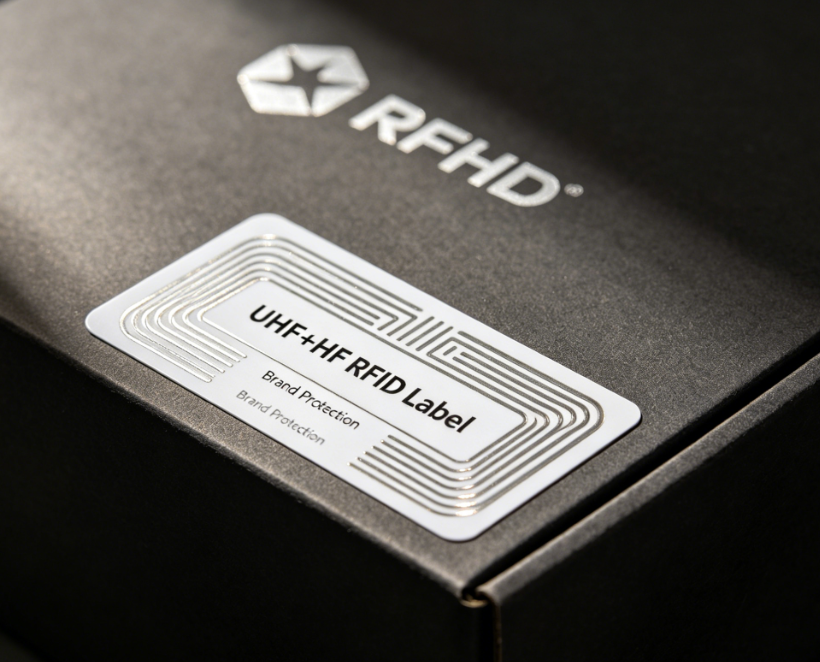
UHF frequency, covering 860–960 MHz, delivers outstanding long-range reading and batch identification performance. It supports a reading distance of up to 10 meters and can scan dozens of tagged products at one time in high-speed moving scenarios. This capability completely solves the efficiency bottleneck of traditional manual inspection and single-point identification. In large-scale manufacturing workshops, central warehouses and cross-regional logistics and transportation links, enterprises can rely on UHF RFID equipment to realize automatic inventory counting, real-time cargo tracking and outbound and inbound verification. It greatly improves the digital management level of the supply chain, effectively prevents goods diversion, channel dumping and cross-regional sales chaos, and blocks the profit space of the grey market.
Complementing UHF’s logistics advantages, the HF/NFC 13.56 MHz frequency focuses on terminal secure authentication and consumer interaction. Featuring short reading distance, high encryption security and strong anti-interference ability, HF frequency supports precise item-level verification. Unlike copyable QR codes, dual-frequency RFID labels adopt chip-level encryption and unique ID coding technology. Each label has an unalterable exclusive digital identity. Once the label is torn, transferred or artificially damaged, the internal circuit will fail permanently, realizing anti-tampering and anti-reuse functions.
More importantly, the HF/NFC function enables zero-threshold authenticity verification. End consumers and offline retailers can complete product authenticity identification by simply tapping the product label with a smartphone, without professional reading equipment. This open and convenient verification mode builds a transparent trust bridge between brands and consumers, thoroughly solving the pain point that traditional anti-counterfeiting technologies rely on professional testing and cannot be popularized in terminal scenarios.
Industry insiders point out that the rise of dual-frequency UHF+HF RFID labels is essentially an upgrade from “single anti-counterfeiting” to “full-lifecycle brand governance”. In the past, brand anti-counterfeiting was limited to terminal product verification, failing to track source production and circulation links, resulting in counterfeiting and channel chaos that could not be fundamentally eradicated. Dual-frequency RFID technology breaks this dilemma. The UHF band undertakes full-process supply chain tracking and channel supervision, while the HF band undertakes terminal anti-counterfeiting authentication and consumer engagement. The two frequencies cooperate efficiently to form a closed-loop management system of “source traceability – circulation supervision – terminal verification – consumer interaction”.
At present, dual-frequency RFID labels have been widely deployed in high-value and high-counterfeit-risk industries such as luxury goods, wine and spirits, cosmetics, electronic appliances and pharmaceutical products. For high-end wine brands, reusable empty bottles have long been a key difficulty in counterfeiting. Fake merchants recycle genuine bottles to fill counterfeit wine, which is hard to identify through traditional means. After adopting dual-frequency RFID labels, each wine bottle is bound with a unique digital identity. The system records production batch, circulation track and sales information. The anti-tampering design ensures that the label cannot be reused after opening, completely curbing the phenomenon of genuine bottle fake filling.
In the field of cross-border retail and commodity circulation, the advantages of dual-frequency labels are also prominent. Brands can use UHF long-distance batch scanning to complete rapid customs clearance and inventory management, improving the efficiency of cross-border logistics. Meanwhile, retailers and market supervisors can use NFC short-distance reading to conduct random inspection and anti-counterfeiting verification on the spot, effectively cracking down on parallel imports and counterfeit goods that disrupt the market order.
With the continuous maturity of chip technology and the gradual reduction of application costs, dual-frequency UHF+HF RFID labels are accelerating their popularization from high-end scenarios to mass consumer goods industries. Leading RFID manufacturers continue to optimize product performance, launching lightweight, customizable and environmentally friendly dual-frequency label products, which are suitable for various packaging materials and production processes, and greatly reduce the threshold for brand application.
As brand infringement means become more concealed and market competition becomes more standardized, traditional passive anti-counterfeiting methods are gradually losing their effectiveness. Dual-frequency UHF+HF RFID labels, with their dual-scenario capabilities of efficient supply chain management and high-precision anti-counterfeiting authentication, have become an indispensable core tool for global brand asset protection. Industry analysts predict that in the next three years, dual-frequency RFID traceability and anti-counterfeiting solutions will become the standard configuration of mid-to-high-end brand operation, helping enterprises build an impenetrable brand security line in the digital era.